Testosterone treatment: which forms give steady levels, and which swing the most?
Pastuszak et al. · Andrology 2022;10(2):209–222
Pastuszak A. W., Gittelman M., Tursi J. P., Jaffe J. S., Schofield D., Miner M. M.
Open the publication ↗ · DOI: 10.1111/andr.13108Educational content, not medical advice. Testing and treatment decisions belong with a physician.
On this page (17)
- What does stability mean in testosterone treatment?
- From steady to unstable: all forms on one scale
- Weekly subcutaneous testosterone injection
- Intramuscular testosterone injection: cypionate and enanthate
- Intramuscular testosterone injection: undecanoate (Nebido)
- Pellets under the skin
- Testosterone gel and solution on the skin
- Testosterone patch
- Nasal gel
- Testosterone capsules (oral undecanoate)
- Buccal system
- Figure 1: the curves side by side
- The body's own daily curve as a yardstick
- Commentary and supplementary research — after the study summary
- Divided testosterone dosing: 2–3 times weekly
- What do the swings mean for your blood test?
- Questions & answers
Figure 1 · Testosterone curves from the publication
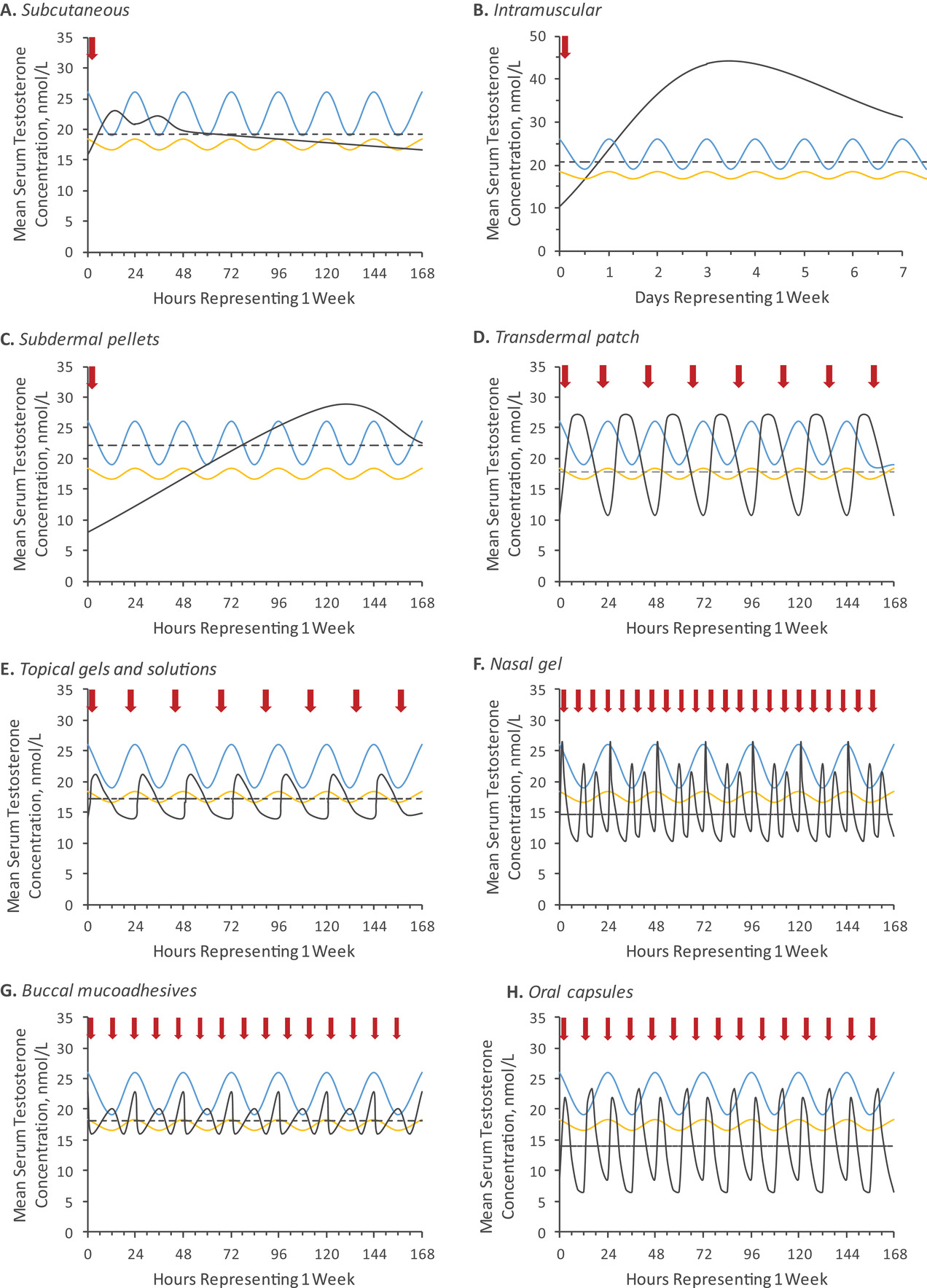
Blue: young men. Yellow: older men. Black: testosterone treatment. Red arrows: dosing. Dashed: weekly mean. Panels B and C show only the first week after dosing, not the full injection or pellet interval. These are the review's modelled illustrations, not a head-to-head trial.
Pastuszak et al. · Andrology 2022;10(2):209–222 · DOI: 10.1111/andr.13108. © 2021 The Authors · CC BY-NC-ND 4.0.
Open the original figure and caption ↗What does stability mean in testosterone treatment?
Every approved form aims at the same thing: bringing average testosterone into the normal range. According to the review, all forms can improve symptoms of low testosterone. What separates them is the curve between doses: how high the peak goes, how deep the trough falls, and how often that happens.
A simple measure of this is the peak-to-trough ratio. A ratio of 1.8 means the peak is 1.8 times the trough. The closer to 1, the steadier. For comparison, the body's own daily curve sits at about 1.3 in young men and 1.2 in older men.
How and how often a form is given shapes the curve. A large dose at long intervals usually gives a high peak and a deep fall. Small, frequent doses give more, smaller swings. A depot that releases hormone slowly gives a flatter curve.
From steady to unstable: all forms on one scale
| Form | Dosing in the study | Peak-to-trough ratio |
|---|---|---|
| Body's own curve, young / older | – | about 1.3 / 1.2 |
| Subcutaneous testosterone injection (enanthate) | once a week | 1.8 |
| Testosterone gel 1% | once daily | 2.2–2.4 |
| Intramuscular testosterone injection (undecanoate) | every 10 weeks after loading | 2.6–2.8 |
| Testosterone patch | every evening | 3.0–3.2 |
| Buccal system | twice daily | 3.3 |
| Testosterone capsules (undecanoate) | twice daily with food | close to 4 |
| Testosterone nasal gel | three times daily | 4.7 |
| Intramuscular testosterone injection (cypionate, enanthate) | every 1 to 4 weeks | 2–5.3 |
Pellets are not listed because the paper gives no overall peak-to-trough ratio for them. The numbers come from different studies with different men and doses, so the table ranks orders of magnitude; it is not a head-to-head trial.
* Supplementary model — not a result from Pastuszak et al. Divided testosterone cypionate or testosterone enanthate dosing 2–3 times weekly is shown separately below. This is an illustrative calculation, not measured ratios or an established position in the ranking.
Supplementary comparison* Dosing interval Calculated peak/trough* Testosterone injection, divided weekly dose twice weekly, every 3.5 days about 1.35–1.62* Testosterone injection, divided weekly dose three times weekly, evenly spaced about 1.22–1.38* The model assumes a half-life of 5–8 days, immediate absorption and equal doses at steady state. These are chosen calculation assumptions, not half-lives measured in a trial of these two schedules. See sources and calculation method.
Weekly subcutaneous testosterone injection
The curve: Testosterone enanthate under the skin once a week by auto-injector gave a ratio of 1.8 in a phase 3 study (150 men, 52 weeks). At week 12 the weekly average was 19.2 nmol/l, the peak 27.4 and the trough 15.1 nmol/l. 92.7% were within 10.4–38.1 nmol/l, and none had a peak of 52 nmol/l or more at week 12.
Advantages described: a steady level through the week, little fluctuation in DHT and estradiol, and the patient self-injects into the abdomen. The dose is adjusted from the measured trough.
Drawbacks and caveats: one injection every week. The review was funded by Antares Pharma, and three authors were current or former employees.
Intramuscular testosterone injection: cypionate and enanthate
The curve: The peak comes within a week and can be supraphysiological (above normal). The level then falls, often below the therapeutic range, before the next injection. The ratio ranged from 2 to 5.3 depending on dose and interval. 200 mg cypionate every two weeks tripled testosterone with peaks at 2–3 days (38.4 nmol/l) and 4–5 days (38.6 nmol/l), and estradiol almost tripled. With enanthate the peak exceeded 41.6 nmol/l for all four regimens, from 100 mg weekly to 400 mg every 4 weeks.
Advantages described: long, wide use and flexible dosing (50–400 mg every 2 to 4 weeks). The authors of the enanthate study recommend 200 mg every 2 weeks or 300 mg every 3 weeks to keep the average within the normal range.
Drawbacks: the largest swings of the injectable forms, with high peaks and low troughs. The review says these swings differ greatly from the body's own rhythm. Ester mixtures (such as Sustanon) produce even wider swings than enanthate alone in simulations.
Intramuscular testosterone injection: undecanoate (Nebido)
The curve: Undecanoate acts longer. In the phase 3 study of 750 mg, the peak came about 7 days after injection (30.9 nmol/l), the trough stayed within the reference range at every measurement, and the ratio was 2.6–2.8. 94% had an average within 10.4–34.7 nmol/l. In Europe 1000 mg is given every 10 to 14 weeks.
Advantages described: no supraphysiological peaks like cypionate and enanthate, and few injections a year. The review says undecanoate, with fewer peaks and troughs, may be more acceptable for some men.
Drawbacks: a large oil volume (3–4 ml) given deep into the buttock by trained staff. Turner and colleagues list injection site pain and the risk of pulmonary oil microembolism as known limitations. It takes longer to reach steady state.
Pellets under the skin
The curve: Pellets of crystalline testosterone release hormone over several months. The peak came within the first month, and the level then fell gradually. With 12 pellets (900 mg) the peak was 35.4 and the average 22.1 nmol/l by month 4.
Advantages: few treatments a year (every 3 to 6 months).
Drawbacks: a minor procedure at the clinic is needed. Only 71% stayed above 10.4 nmol/l for at least 3 months, and in a retrospective study the trough fell to 7.7–8.9 nmol/l regardless of the number of pellets.
Testosterone gel and solution on the skin
The curve: Gel is applied once daily, usually in the morning. The peak comes 2–8 hours later, and steady state is reached within a few days. For 1% gel the ratio was 2.2–2.4.
Advantages described: easy to use and among the most used and preferred forms. According to the review, the daily rhythm resembles the natural curve in younger men. The dose can be adjusted in small steps.
Drawbacks: must be used every day, because in most men the level falls below the normal range within 24 hours. The risk of transferring the hormone to others through skin contact is why one solution was made with an applicator.
Testosterone patch
The curve: Applied in the evening, the patch gives a peak in the morning (about 8 hours later) and a slow decline. The ratio was 3.0–3.2.
Advantages: the authors describe it as mimicking the daily rhythm in young men.
Drawbacks: larger swings than gel in the comparative study, and gel caused fewer skin reactions than the patch. The original 5 mg strength is no longer available.
Nasal gel
The curve: three doses daily, 6–8 hours apart. The peak comes after about an hour, and the level falls almost to baseline before the next dose. The ratio was 4.7, and the average relatively low (13.0–14.6 nmol/l at day 90).
Advantages: bypasses the liver, and an ongoing study suggests FSH, LH and semen parameters can be maintained.
Drawbacks: three peaks and troughs a day and one of the highest peak-to-trough ratios in the review.
Testosterone capsules (oral undecanoate)
The curve: two doses daily with food. Two peaks about 4 hours after dosing and two troughs below 6.9 nmol/l 12 hours later. The ratio approaches 4.
Advantages: no injection and no gel on the skin.
Drawbacks: absorption depends on the meal. Levels were about twice as high with food as fasting, and dietary fat increased absorption. Daily troughs below the therapeutic level.
Buccal system
A system placed on the gum twice daily gave a ratio of 3.3, with a morning peak after evening application. The product has been discontinued.
Figure 1: the curves side by side
See Figure 1 in the free open-access original.
The blue curve is the estimated daily curve in young men (23–28 years), the other coloured curve (yellow in the figure) older men (58–82 years). The black line is the treatment, red arrows mark doses, and the dotted line is the weekly average. For intramuscular injections and pellets the figure shows only the first week after dosing.
The body's own daily curve as a yardstick
In healthy men testosterone is highest in the morning and lowest in the late afternoon. In men aged 30 to 40 the morning value is 30–35% higher than in the afternoon; in 70-year-olds only about 10%. Several studies found no clear daily rhythm in men with testosterone deficiency. No treatment copies the natural curve of young or older men, the authors write. The importance of the daily variation itself is not fully understood.
Commentary and supplementary research — after the study summary
The walkthrough of Pastuszak et al. ends here. The following sections are our explanation, a supplementary calculation model and a separate study; they are not results from the Pastuszak review.
Divided testosterone dosing: 2–3 times weekly
Why the interval matters: Dividing the same weekly testosterone amount into more injections leaves less time for levels to fall between doses. A simple pharmacokinetic model therefore produces smaller peak-to-trough swings. This describes the dosing-interval principle, not proven superiority of a particular product or injection route.
What was actually measured: McFarland et al. (2017) followed 11 transgender men receiving weekly subcutaneous testosterone cypionate. Group mean testosterone levels were relatively stable across the week; the overall mean was 627 ± 206 ng/dL. The study did not test 2–3 weekly doses, and the standard deviation cannot be treated as a peak-to-trough ratio. The authors suggested the findings could extend to men with hypogonadism; that was not directly tested. Read McFarland et al..
How the starred figures were calculated: In the model, peak/trough = 2^(interval / half-life). With an assumed half-life of 5–8 days, a 3.5-day interval gives about 1.35–1.62 and a 7/3-day interval about 1.22–1.38. Real oil depots absorb gradually, and results depend on formulation, dose, injection route and individual metabolism. These figures are therefore not a clinical prediction for either cypionate or enanthate.
What we can conclude: More frequent dosing may produce a flatter testosterone curve. The reviewed sources do not establish a specific ratio of 1.25–1.45 or a top-two ranking for cypionate/enanthate dosed 2–3 times weekly. Nor does the model demonstrate fewer symptoms, estradiol peaks or haematocrit increases; those require clinical data. The physician sets the dose and interval and monitors blood tests.
Nebido under the skin instead of into the muscle?
An Australian crossover trial (Turner et al., Journal of the Endocrine Society 2019) gave 20 men who already used undecanoate one 1000 mg injection into the muscle and one under the skin of the abdomen. The order was randomised, and each injection was followed for 12 weeks.
- The peak came later under the skin: after 8.0 days versus 3.3 days in the muscle.
- The model-predicted peak did not differ significantly: 8.4 ng/ml under the skin versus 9.6 ng/ml in the muscle.
- Duration of action was almost the same: 104 versus 101 days. Venous testosterone, DHT and estradiol did not differ between routes.
- The injection under the skin hurt more 24 hours later, but not immediately. 11 preferred the muscle, 6 the skin, and 3 had no preference.
The authors conclude that the subcutaneous route is a possible alternative without a dose change for men in whom intramuscular injection is not wanted or advised, but that more studies are needed. The product is approved for deep intramuscular injection, so injection under the skin is off-label use and a decision for the physician. The study was small, had no external funding and used dried blood spot samples for the curve. Read the study.
What do the swings mean for your blood test?
The bigger the swings, the more the number depends on when the sample is taken. A sample a few days after a cypionate injection can read high and one just before the next injection low, even though the treatment is the same. The Endocrine Society guideline cited in the review recommends measuring midway between enanthate or cypionate injections and just before the next undecanoate injection. Read more about blood tests.
Which form suits you is decided with a physician based on symptoms, blood tests and follow-up. If you are unsure whether your symptoms fit low testosterone: 1) Take the symptom test. 2) Order a blood test. You can also read why a normal testosterone result can mislead.
Questions & answers
Which testosterone form gives the steadiest level?
Among the forms for which the review reports a figure, weekly injection under the skin had the lowest peak-to-trough ratio (1.8), followed by daily gel (2.2–2.4) and intramuscular undecanoate (2.6–2.8). The review was funded by Antares Pharma.
Which forms swing the most?
Nasal gel (4.7), capsules (close to 4) and intramuscular cypionate or enanthate (2–5.3). The latter can produce peaks above the normal range and troughs below the therapeutic level.
Can Nebido be given under the skin?
A small crossover trial in 20 men found no significant difference in peak level and a similar duration of action under the skin versus the muscle, but the peak came later and it hurt more after 24 hours. It is off-label use and a decision for the physician.
When should the blood test be taken during treatment?
According to the guideline cited in the review, midway between injections for enanthate and cypionate and just before the next injection for undecanoate. Agree the timing with your physician.
Who funded the studies?
The Pastuszak review was funded by Antares Pharma. The Turner trial had no external funding.