Systemic fatigue and energy drop
Often the first thing men notice. It is easy to write off as work or age, and it is a reason to measure, not to guess.
Workup with no GP referral
Fatigue, brain fog or belly fat that will not move? Start with a free symptom test — or go straight to blood work.
EU telemedicine. Prescription after work-up and medical assessment of symptoms and blood tests.
The fall appears across independent cohorts in the US, Denmark and Finland, it shows no sign of flattening, and no European government measures it or raises the alarm. The consequences are wide: insulin resistance, weight gain, type 2 diabetes, muscle loss, osteoporosis, low mood or depression and premature ageing — in the young as well as the old.
Often the first thing men notice. It is easy to write off as work or age, and it is a reason to measure, not to guess.
Poorer concentration and a flatter sense of drive. Several causes exist. A hormone panel shows whether testosterone is one of them.
Worse glucose handling and a higher measured risk of type 2 diabetes in men with low testosterone. The blood test is the next step.
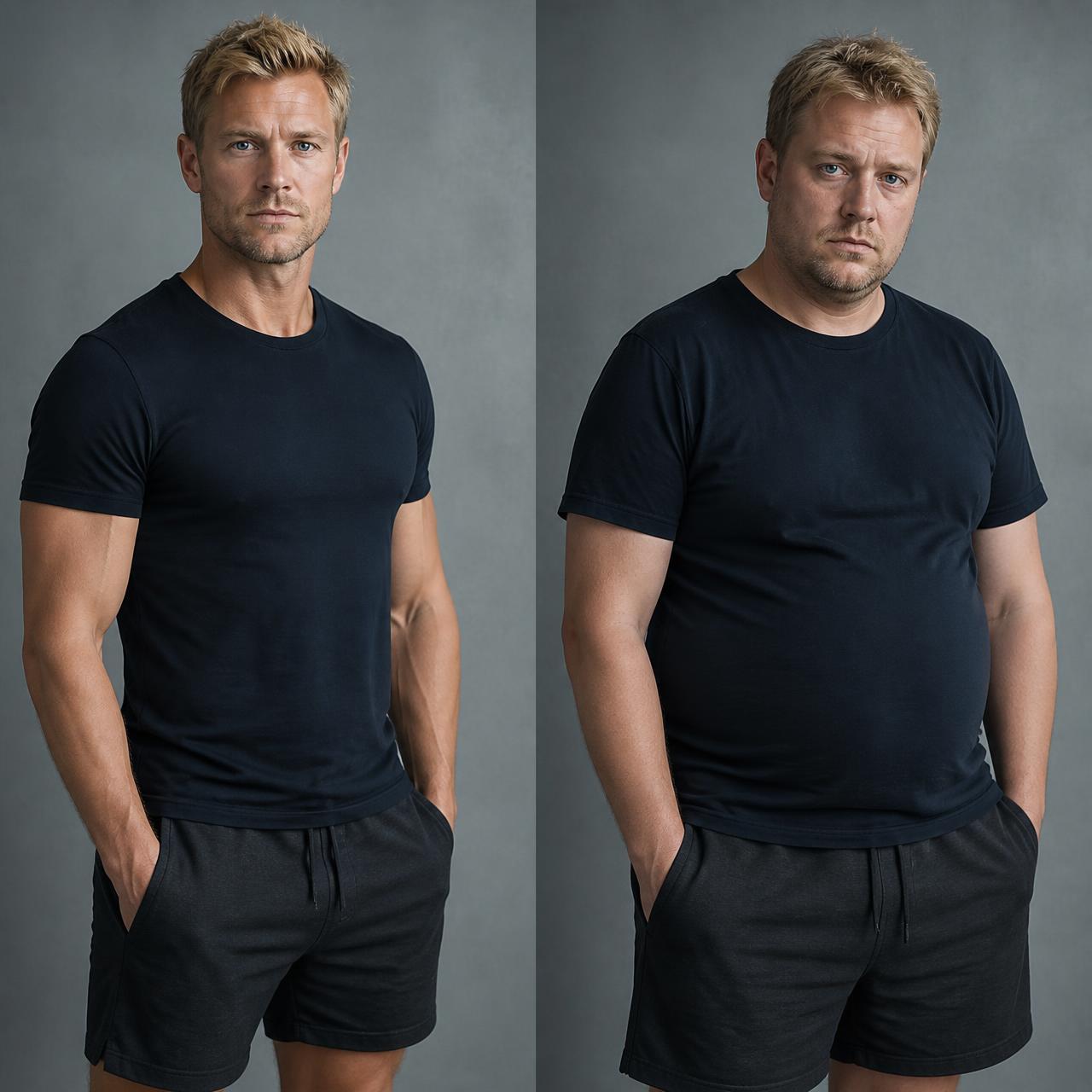
Abdominal fat and loss of muscle. Fat tissue converts testosterone, which can deepen the problem. Measure before you decide.
Lower libido, fewer morning erections, weaker erectile firmness. Zitzmann 2006 linked the first of these to levels around 15 nmol/L.
Clinical replacement starts with a validated assessment. Take the free symptom questionnaire and get an indication now, before you order a test.
Total and free testosterone across adulthood: the healthy-young reference range versus today's population average. Some symptoms attributed to getting older can have a hormonal cause, which is why measurement matters.
Average testosterone, 1972–2019 · 118,593 men in five countries (ESHRE 2026 pooled conference analysis).
Same-age difference: 21.9 to 13.8 nmol/L in Finnish men aged 60–69 (3,271 men; Perheentupa et al. 2013).
The decline also reaches adolescents and young adults and remained significant at normal BMI (NHANES; Lokeshwar et al. 2020/2021).
A young man at 16 nmol/L is not 10 or 20 percent short of where young men sat. Men aged 25–29 in the Finnish data averaged about 25 nmol/L (Perheentupa et al. 2013). From 16 that is about a 60 percent rise, just to reach that average. Double, about 32 nmol/L, is only the upper end of the healthy young range (Travison et al. 2017).
Clinical context
Hover or focus a point for age, level and both unit systems.
Early / individual symptoms13–19 nmol/L · 375–548 ng/dLZitzmann et al. (2006) found the first symptom associations around 15 nmol/L: reduced libido, declining vigor and energy, weaker morning erections, poorer recovery after exercise, lower motivation and flatter mood. Symptoms are individual and relate to the fall from your own younger baseline — not a fixed cut-off.
Sexual symptoms become more likely11–13 nmol/L · 317–375 ng/dLBelow ~12–13 nmol/L the associations widen in Zitzmann et al. (2006) and EMAS: markedly reduced sex drive, erectile dysfunction, absent morning erections, reduced physical strength and endurance, growing belly fat, difficulty building or maintaining muscle, and increasing insulin resistance / prediabetic drift.
Marked deficiency range< 11 nmol/L · < 317 ng/dLBelow ~10–11 nmol/L every symptom group becomes strong and clustered: weight gain and increased fat mass (especially abdominal), loss of muscle mass and strength, metabolic problems including type 2 diabetes and metabolic syndrome, loss of bone density (osteoporosis), depression and low mood, chronic fatigue, sleep problems, hot flushes, reduced cognitive performance — and severely reduced libido, erection strength and fertility. This is the range where the hypogonadal-obesity cycle takes over: low T drives fat gain, and fat aromatises testosterone away, deepening the deficiency.
Type 2 diabetes and metabolic syndrome are downstream problems that researchers describe as a consequence of low testosterone. First it becomes difficult or impossible to maintain muscle mass and body weight; fat mass increases, especially around the abdomen — which then suppresses testosterone further. Researchers call this vicious circle the hypogonadal obesity cycle.
In observational registries, some treated men with deficiency and type 2 diabetes reached remission, and the randomised T4DM trial found fewer cases of type 2 diabetes after two years with testosterone than with lifestyle measures alone. These results apply to men with confirmed deficiency. They do not mean that all men with type 2 diabetes should be treated, and higher doses are not better.
Read the full evidence index →Testosterone falls below the symptom threshold — energy, drive and training capacity decline first.
Muscle mass becomes hard to maintain and resting metabolic rate falls.
Fat mass increases, concentrated around the abdomen.
Abdominal fat is rich in aromatase, converting testosterone into estradiol and suppressing the signal to produce more.
Lower testosterone again — insulin resistance, higher fasting glucose and eventually type 2 diabetes.
These associations come from studies of men with confirmed deficiency. Treatment is not a general anti-ageing measure, and results vary between men.
In treated deficiency, studies have reported reductions in fat mass and waist circumference alongside lifestyle measures.
In dose–response studies, lean mass and strength increased with the achieved hormone level. In older men the effects on muscle function have been modest.
In a small clamp study, tissue glucose uptake in response to insulin rose by 32–35% with treatment of hypogonadism.
In an observational registry with up to 11 years of follow-up, approximately 34% of treated hypogonadal men with type 2 diabetes reached remission. A registry cannot prove cause and effect.
Low drive, poor concentration and low mood can have hormonal causes, but also many others, such as stress or depression.
Low testosterone is associated with visceral fat, low-grade inflammation and insulin resistance. Whether treatment changes this is assessed individually.
Two minutes, answered instantly. It maps your symptoms against the domains that track free testosterone.
A blood test is required so the endocrinologist can see your free testosterone and relevant markers, and relate them to your symptoms.
When you have your blood results, we can book a consultation where the endocrinologist concludes on your symptoms and labs — and if treatment is indicated and you want it, it is started and you agree the form of testosterone (cream, subcutaneous or IM).
Three papers explain most of what men are told is simply age: where symptoms begin, which ones are often felt first, why there is no single cut-off, and what happens to type 2 diabetes when the deficiency is corrected.
Lack of energy appears to be the most important symptom that predicts a total testosterone level of 400 ng/dL (14 nmol/L) or below.
Scovell et al. found that symptoms of low testosterone in young men, appear at a serum total testosterone threshold of 400 ng/dL (14 nmol/L) — well above the cut-off most European laboratories use. Alongside lack of energy was sadness, decreased strength and endurance, decreased ability to play sports and deterioration in work performance, which were most strongly predictive of low testosterone.
Prevalence of psychosomatic symptoms and metabolic risk factors accumulated with decreasing androgentestosterone levels. For example, prevalence of loss of libido or vigour, increased below testosterone concentrations of 15 nmol/L (P < 0.001), whereas depression and diabetes type 2 (also in non-obese men) were significantly more present in men with testosterone concentrations below 10 nmol/L.
Zitzmann et al. widen the threshold further: the first symptoms appeared around 15 nmol/L, but the authors note there was no clear-cut boundary — some men experience symptoms earlier than others. Cluster analysis revealed ageing men to present within three independent groups, characterised by 1) psychosomatic complaints 2) metabolic disorders 3) sexual health problems
Testosterone therapy is potentially a novel additional therapy for men with type 2 diabetes and hypogonadism.
Haider et al. followed 356 men with type 2 diabetes and testosterone below 350 ng/dL (12.1 nmol/L); 178 men received long-acting testosterone therapy prescribed by their physician. Treated patients showed significant, progressive and sustained reductions in both fasting glucose, HbA1c and fasting insulin. 34.3% achieved full remission of their diabetes and 46.6% achieved normal glucose regulation. In the testosterone group 83% reached the HbA1c target of 47.5 mmol/mol (6.5%) and 90% the target of 53 mmol/mol (7%).
“For decades, low testosterone was ignored or feared. The real medical threat isn't restoring healthy levels; it's letting men suffer in silence with low testosterone.”
Laboratory “normal” ranges are drawn from a declining population. Measured against healthy non-obese young men in the Framingham cohort (Bhasin et al. 2011), today's average man sits far down that distribution.
| Period | Total T average | Total T, healthy young reference | Free T average | Free T, healthy young reference |
|---|---|---|---|---|
| 1987–89 · MMAS (Travison 2007) | 17.4 nmol/L | up to 41.5 nmol/L in healthy young men | 350 pmol/L | — |
| 1995–97 · MMAS follow-up | 15.6 nmol/L | — | 310 pmol/L | — |
| 2002–04 · MMAS / NHANES onwards | 13.6 nmol/L | — | 270 pmol/L | — |
Symptoms correlate far more strongly with free testosterone than with total testosterone — the finding most standard consultations still miss.
Upper part of the reference data for healthy young men. A reference position, not a treatment target.
Within the usual laboratory reference range.
Grey zone: symptoms such as fatigue are reported more often here, but the number alone does not make a diagnosis.
Below common laboratory limits. A diagnosis requires symptoms and a repeat measurement.
Already in treatment?
If your protocol peaks around 20 nmol/L and drops close to 10 before the next injection, you may be one of those who feel the trough more than the treatment, and watch old symptoms return before the next shot. If you want a second opinion, our physicians will review your options with fresh eyes. Ask about clean-label testosterone for subcutaneous use.
Get a second opinion →For women
Oestrogen falls up to 90% through menopause while testosterone falls roughly 50% — reshaping the ratio that governs bone density, muscle tone, cognition and libido. See the female charts, the free testosterone symptom bands and how a physician assesses hormone levels.
Women's hormonal status →“Treat the patient, not the paper. A blood test gives you a number, but the man sitting in front of you gives you the reality.”